 Special Offer: Your first question is on us. Ask your free question now.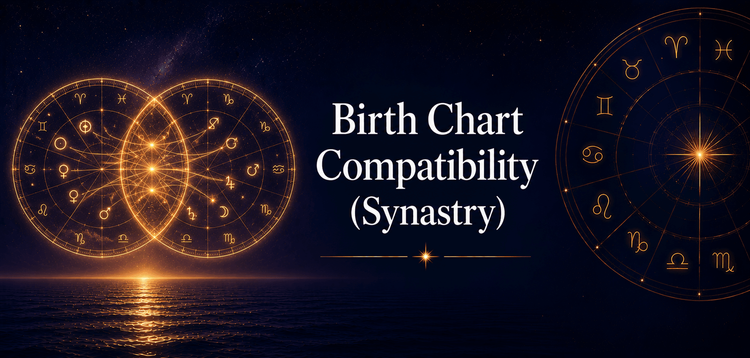
Wondering if you're meant to be? Learn how synastry and birth chart compatibility reveal relationship strengths — then get a personalized reading.
Every couple has asked some version of this question at 2am: are we actually compatible, or does it just feel that way right now? Birth chart compatibility — the practice astrologers call synastry — is one of the oldest tools for answering that question with more than gut feeling. It won't hand you a guarantee, but it will show you, in detail, where two people naturally support each other and where they'll need to work a little harder.
If you're seriously evaluating a relationship — dating with intention, engaged, or thinking about marriage — this guide walks through exactly how synastry works and how to read your own chart overlay.
What Is Synastry, Exactly?
Synastry is the branch of astrology that compares two birth charts against each other to assess relationship dynamics. Instead of looking at one person's planets in isolation, a synastry chart reading overlays both charts and studies how each person's planets interact with the other's.
The idea is simple: your Venus doesn't just sit quietly in your own chart. When compared to someone else's Mars, or their Moon, or their Ascendant, it forms angles — the same conjunctions, trines, squares, and oppositions used in any astrological reading, just applied between two people instead of one.
Those angles describe the texture of a relationship. Where do you naturally feel understood? Where does attraction spark instantly? Where might you misread each other, even with good intentions? Synastry maps all of it.
The Planets That Matter Most in Compatibility
Not every planetary connection carries equal weight. If you're learning how to read synastry for the first time, start with these core placements.
Sun and Moon connections. Your Sun represents your core identity; your Moon represents your emotional needs. When one partner's Sun aligns well with the other's Moon (or vice versa), there's usually a natural sense of "being seen." This pairing often shows up in relationships that feel easy from the start.
Venus and Mars. This is the classic attraction axis. Venus represents how you love and what you're drawn to; Mars represents desire and drive. Strong Venus-Mars connections between two charts frequently correlate with real chemistry — the kind that doesn't fade quickly.
Moon to Moon. Two Moons in harmonious aspect (trine or sextile) often means emotional rhythms sync up naturally — you regulate each other rather than escalate each other during stress.
Ascendant connections. Your Ascendant is how you present to the world. When someone's planets land near your Ascendant, there's frequently an instant, almost magnetic first impression — the "I felt like I already knew you" effect.
Saturn contacts. Saturn gets an unfairly bad reputation, but in synastry it often signals staying power. Saturn connecting to someone's Sun, Moon, or Venus can indicate a relationship built for the long haul — one that asks for commitment and maturity rather than just chemistry.
Reading the Houses: Where the Relationship Lives
Beyond planet-to-planet aspects, relationship compatibility astrology also looks at which houses get activated when you overlay two charts. If your partner's planets consistently fall into your 7th house (partnership), 5th house (romance and pleasure), or 8th house (intimacy and merging), that's a strong signal the relationship touches those specific life areas directly.
A concentration of contacts in the 7th house, for example, often shows up in relationships that feel like genuine partnerships — decisions made together, identities that evolve as a pair. Heavy 8th house contact, meanwhile, tends to show up in relationships with intense emotional and physical closeness, sometimes described as "all in" from early on.
Common Synastry Patterns and What They Tend to Mean
A few patterns come up again and again in serious relationship charts:
- Venus trine Venus or Moon trine Moon — easy compatibility, shared values, low-conflict harmony. Comfortable, but worth checking that there's enough spark alongside the ease.
- Mars square Mars — friction and competitiveness, which can either fuel passion or create recurring power struggles depending on how both people handle conflict.
- Sun conjunct Ascendant — strong mutual recognition and attraction, often reported as feeling instantly drawn to each other.
- Saturn square Venus — a relationship that requires real effort and patience, often maturing slowly rather than starting easy, but capable of becoming very solid once trust is built.
None of these patterns are automatically "good" or "bad" on their own. A chart with zero tension can lack the friction that generates growth; a chart with some challenging aspects alongside strong supportive ones often makes for the most resilient long-term partnerships. Context — and the rest of both charts — always matters.
How to Actually Read Your Own Synastry Chart
If you want to try this yourself before booking a professional reading, here's a simple starting process:
- Get both accurate birth charts. You'll need date, time, and location of birth for both people — an approximate time can shift house placements significantly, so exact birth time matters here.
- Overlay the charts. Most astrology software or apps can generate a synastry chart directly; this shows both sets of planets on one wheel.
- Start with the "big four." Look first at Sun-Moon, Venus-Mars, Moon-Moon, and Ascendant connections before getting lost in minor aspects.
- Note the aspect type. Trines and sextiles indicate ease; squares and oppositions indicate tension (which isn't inherently bad, just requires more conscious effort); conjunctions intensify whatever the planets represent.
- Look at the whole picture, not one aspect. A single difficult aspect rarely defines a relationship. It's the overall balance of ease and challenge across dozens of connections that tells the real story.
Curious how your own chart lines up with someone specific? Ask your first compatibility question free and get an initial read on where your charts naturally align.
Why a Professional Reading Goes Deeper Than an App
Free synastry generators are a good starting point, but they typically stop at listing aspects without interpreting how those aspects actually play out for your specific charts, current transits, and life stage. A trained astrologer reads synastry the way an experienced doctor reads an X-ray — not just noting what's there, but understanding what it means in context.
This matters even more if you're evaluating a serious commitment. Someone weighing an engagement or considering long-term compatibility isn't just curious about "do we vibe" — they want to understand where real friction might show up years down the line, and whether the foundation is strong enough to handle it.
If you'd rather go deeper than app-generated aspect lists, a full birth chart analysis can walk through your synastry alongside your individual charts, giving you a complete picture of both your personal patterns and how they interact with your partner's.
It's also worth reading synastry alongside other compatibility signals — many people cross-reference it with their Soulmate Zodiac signs or general marriage and relationship guidance for a fuller view before making a major decision.
Red Flags Synastry Can Reveal Early
Synastry isn't only about confirming a good match — it can also flag patterns worth paying attention to before they become bigger issues:
- Repeated hard aspects between one person's Mars and the other's Moon or Venus, which can indicate recurring conflict around anger or emotional safety
- Saturn heavily afflicting the other partner's Sun or Moon, sometimes correlating with feelings of restriction or being controlled
- Little to no connection between the two Suns or Moons at all, which can show up as partners who struggle to feel truly "known" by each other over time
None of these are automatic dealbreakers, but they're worth discussing openly with a partner — and worth exploring more deeply with someone trained to interpret them accurately rather than reading a single aspect in isolation.
Final Thoughts: What Synastry Can and Can't Tell You
Synastry won't tell you whether you're "meant to be" in some fated, absolute sense — no chart can promise that. What it can do is show you, with real specificity, where a relationship's natural strengths lie and where it will ask more of both people involved. For anyone seriously evaluating a relationship's future, that kind of clarity is genuinely valuable — not as a verdict, but as a map.
If you're ready to see exactly how your charts align, book a full compatibility reading with one of our experienced astrologers. We'll walk through your synastry in detail and help you understand what it means for the relationship you're building.